Versatile Performance
They offer low surface resistance, high electrical conductivity, and effective electromagnetic shielding without compromising optical transparency.
DMD
DMD multilayer thin films combine high optical transmittance, superior electrical conductivity, and advanced electromagnetic shielding performance in a single structure, developed with TEKNOMA’s advanced engineering and precision manufacturing infrastructure.
Produced using magnetron sputtering technology, these new generation coatings can be applied with high homogeneity onto soda-lime (float) glasses, large area glass surfaces, PC, PMMA, PET, and various flexible polymer substrates.

They offer low surface resistance, high electrical conductivity, and effective electromagnetic shielding without compromising optical transparency.
Thanks to ultra-thin metal interlayers, EMI shielding, transparent radar absorbing material technologies, infrared reflection, and transparent conductive surface applications are united on a single platform.
They offer an innovative infrastructure for the defense industry, aerospace, smart glass technologies, and advanced electronic systems.
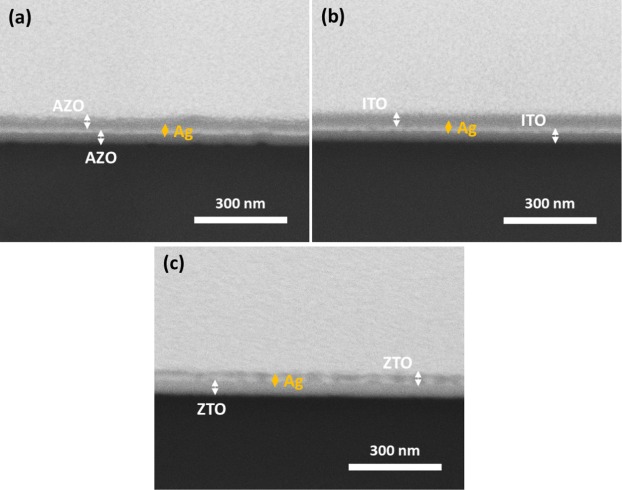
To meet diverse application requirements, three fundamental DMD multilayer thin film structures are produced: ITO/Ag/ITO, ZTO/Ag/ZTO, and AZO/Ag/AZO.
ITO/Ag/ITO multilayer thin-film structures are produced for applications requiring the highest optical and electrical performance at industrial standards.
The ZTO/Ag/ZTO structure has been developed against the micro-cracking problems that traditional coatings face on bendable or curved surfaces.
The AZO/Ag/AZO structure is produced for large-area coating requirements and cost-oriented sustainable projects.
The 7-month aging tests of ITO/Ag/ITO multilayer thin films produced by TEKNOMA show that optical stability is preserved.
| Sample | Thickness (nm) | Initial optical transmittance (%T) | Optical transmittance after 7 months (%T) |
|---|---|---|---|
| Uncoated-PC | - | 75.8 | 75.8 |
| ITO/Ag/ITO/PC | 100.8 | 67.5 | 67.1 |
Only a 0.4% change after 7 months shows that the outer ITO layers isolate the centrally located ultra-thin Ag interlayer from atmospheric effects, oxidation, and moisture.
The success of a DMD structure depends on precisely optimizing the thickness balance of the dielectric and metal layers.
| Sample | Surface resistance SLG (ohm/sq) | Surface resistance PET (ohm/sq) | 550 nm %T SLG | 550 nm %T PET |
|---|---|---|---|---|
| Uncoated | - | - | 91.6 | 59.2 |
| ZTO | HR* | HR* | 83.1 | 54.9 |
| ZTO/Ag | 57.0 | 14.0 | 74.9 | 50.9 |
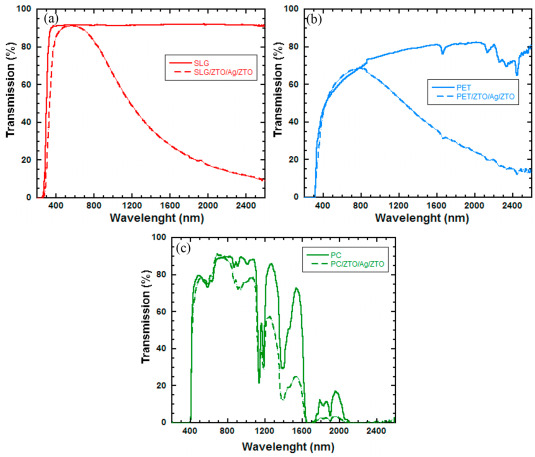
| ZTO/Ag/ZTO | 12.6 | 20.8 | 88.9 | 62.0 |
HR*: High Resistance. The ZTO/Ag/ZTO structure reaches 12.6 ohm/sq surface resistance on glass while increasing transmittance to 88.9%.
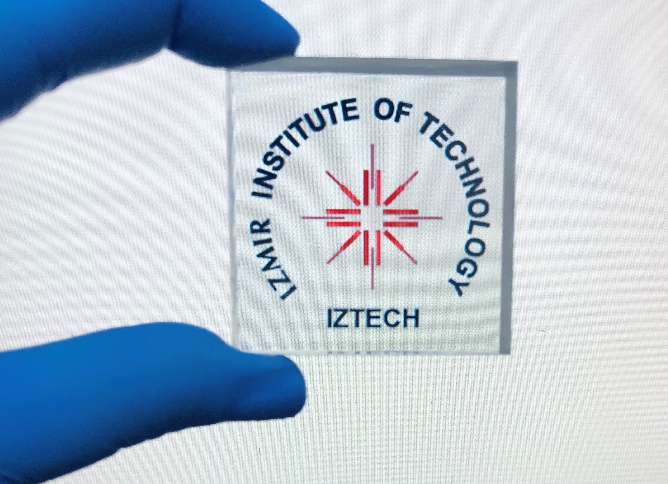
The AZO/Ag/AZO multilayer structure is a strong alternative to thick single-layer ITO coatings widely used in industry, both in performance and material savings.
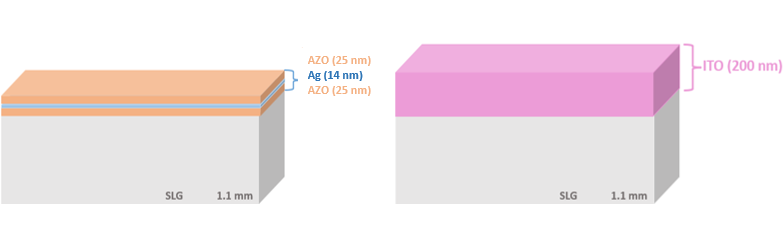
| Material | Thickness (nm) | Surface resistance (ohm/sq) | 550 nm %T |
|---|---|---|---|
| Uncoated Standard Glass (SLG) | - | - | 91.6 |
| Single Layer Conventional Glass (SLG/ITO) | 200 | 17.5 | 84.6 |
| TEKNOMA Multilayer Glass (SLG/AZO/Ag/AZO) | 25/14/25 | 6.0 | 91.2 |
The electrical and optical performance of ZTO/Ag/ZTO coatings on glass and flexible polymer substrates is supported by literature references.
| Sample | Surface resistance (ohm/sq) | 550 nm %T |
|---|---|---|
| SLG (Standard Glass) | - | 91.6 |
| ZTO/Ag/ZTO/SLG | 8.6 ± 0.2 | 91.2 |
| PC (Polycarbonate) | - | 75.7 |
| ZTO/Ag/ZTO/PC | 6.7 ± 0.2 | 77.2 |
| PET (Polyethylene Terephthalate) | - | 59.2 |
| ZTO/Ag/ZTO/PET | 11.2 ± 0.2 | 62.0 |
| TCO | Average surface resistance (Ω/sq) | Average thickness (nm) | %T @ 545 nm | Δ%T (350-750 nm) |
|---|---|---|---|---|
| ITO | 12.65 ± 0.26 | 190.88 ± 0.98 | 86.67 | 82.62 |
| ZAZ | 9.94 ± 1.06 | 55.69 ± 3.96 | 90.32 | 87.46 |